
The Central Bank of India (CBI) has officially issued a critical extension notice for its massive apprentice recruitment drive for the financial year 2026–27. Initially scheduled to close on June 22, 2026, the public sector banking institution has formally pushed the final registration deadline back to June 28, 2026. This sudden extension provides an eleventh-hour window of opportunity for thousands of recent university graduates across the country who missed the initial application timeline.
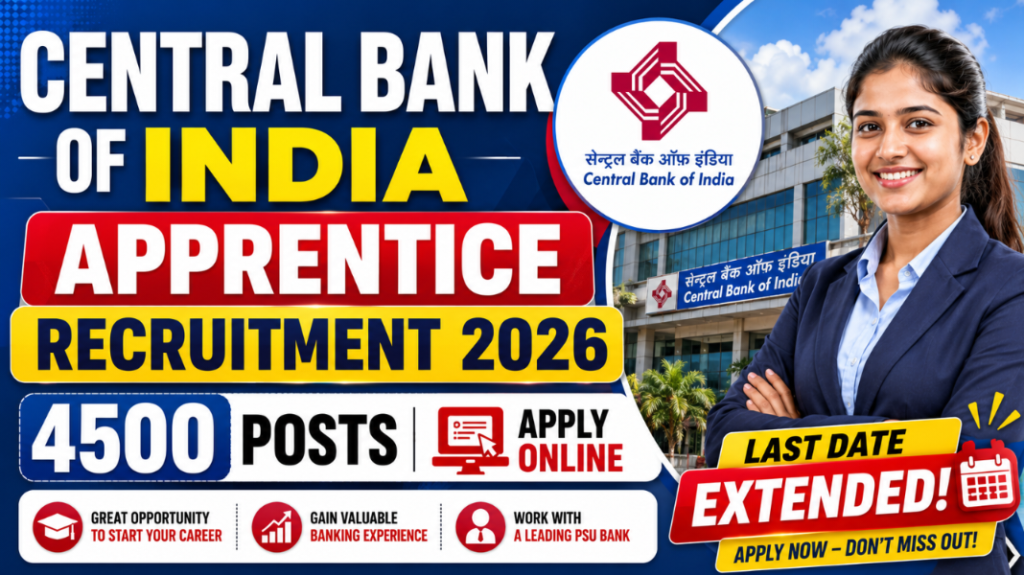
With a massive pool of 4,500 training vacancies spread across branches in nearly every Indian state and union territory, this initiative represents one of the largest financial sector apprenticeship programs of the year. Operating under the structural guidelines of the national Apprentices Act of 1961, the program aims to cultivate functional banking skills among young professionals while offering them an active gateway into the highly competitive Indian corporate banking arena.
Haryana HSSC CET Group D Recruitment 2026: Notification Out, Apply Online for Group D Post
Central Bank of India Apprentice Recruitment Overview Table
To help you quickly scan the essential components of this active recruitment campaign, we have compiled a definitive summary dashboard below. Ensure that you record these dates and fees carefully before mapping out your online submission sequence on the government portals.
| Recruitment Component | Verified Official Specifications for 2026 Cycle |
| Name of the Organization | Central Bank of India (CBI) |
| Current Training Scheme | Engagement of Apprentices (Apprentices Act, 1961) |
| Total Nationwide Vacancies | 4,500 Dedicated Training Seats |
| Initial Registration Close | June 22, 2026 |
| Extended Last Date to Apply | June 28, 2026 |
| Final Date for Fee Payment | June 28, 2026 |
| Tentative Written Exam Date | First Week of July 2026 |
| Allocated Training Tenure | 12 Months (1 Complete Year) |
| Monthly Financial Stipend | ₹15,000 Per Month Consolidated |
| Official Entry Interfaces | nats.education.gov.in & beep.bfsissc.com |
- All applications must successfully pass through a two-tier registration network involving the National Apprenticeship Training Scheme (NATS) framework and the BFSI Sector Skill Council engine.
- The cut-off point for all primary age parameters and university final graduation marks remains set precisely at May 31, 2026.
State-Wise and Region-Wise Vacancy Allocations
The 4,500 training spaces are intentionally distributed across India to ensure regional representation and balanced operational staffing. Candidates must evaluate their home state allocations before filing their online preference parameters:
- Northern Region Centers: Heavy seat allocations across Haryana (137 vacancies), Himachal Pradesh (55 vacancies), and the National Capital Territory of Delhi (97 vacancies).
- Eastern and Central Zones: Bihar stands out as a high-density recruitment hub with 433 vacancies, paired closely with heavy allocations in neighboring Uttar Pradesh and Madhya Pradesh.
- Western Industrial Belts: Gujarat features 305 training seats, while Maharashtra hosts a significant chunk of urban and semi-urban banking apprentice slots.
- Southern Regional Hubs: Andhra Pradesh holds 128 open seats, while major clusters are similarly operational across Tamil Nadu, Karnataka, and Telangana branches.
- North-Eastern Clusters: Dedicated allocations across Assam (118 vacancies) alongside smaller regional pods in Arunachal Pradesh, Mizoram, and Nagaland branches.
Detailed Post Description and Core Training Objectives
Before submitting your digital forms, it is essential to understand what an apprenticeship with the Central Bank of India actually entails. This is fundamentally a professional training program rather than an immediate direct entry into permanent officer or clerk tracks.
- Operational Orientation: Apprentices spend their 12-month tenure embedded within selected branches, receiving hands-on instruction regarding daily retail banking functions.
- Product Exploration: Trainees learn the internal mechanics of core banking services, spanning savings accounts, fixed deposits, credit instruments, and digital application setups.
- Customer-Facing Duties: You will be cross-trained to manage customer inquiries, guide visitors through digital kiosks, and assist with basic documentation screening workflows.
- Administrative Exposure: Learning how to process compliance paperwork, archive records systematically, and utilize modern banking software suites under strict professional supervision.
Basic Educational Eligibility and Graduation Cut-Offs
The Central Bank of India maintains distinct, strict parameters regarding who qualifies to join this 4,500-seat apprentice cadre.
- Baseline Academic Standard: You must hold a valid, verifiable Bachelor’s Degree (Graduation) in any academic stream from an institution recognized by the University Grants Commission (UGC).
- Crucial Passing Date Filter: Candidates must have completed and successfully cleared their graduation requirements on or after January 1, 2022.
- Disqualification Factors: Anyone who completed their degree prior to January 2022 is structurally ineligible to apply. Furthermore, individuals who have already undergone any prior formal apprenticeship training or possess more than one year of commercial work experience are explicitly barred.
- Document Readiness: You must have your final degree passing certificates or consolidated marks sheets ready for submission before the extended June 28 deadline.
Mandatory Age Boundaries and Specific Cut-Off Benchmarks
Age boundaries are closely regulated for this entry-level nationwide banking initiative, with compliance measured against a fixed historical date.
- Minimum Age Parameter: Candidates must have crossed the minimum age mark of 20 years as of May 31, 2026.
- Maximum Age Parameter: Applicants must not exceed the upper age ceiling of 28 years as of the same May 31, 2026 cut-off date.
- Date of Birth Boundaries: Formally, unreserved and EWS applicants must have been born precisely between May 31, 1998, and May 31, 2006 (with both reference dates inclusive).
- Verification Protocols: Your age will be verified strictly using your 10th-grade matriculation passing certificate or official birth records during document validation.
Category-Wise Upper Age Relaxations
In compliance with statutory government directives, the bank extends clear age relaxation buffers to various reserved social segments.
- SC and ST Applicants: Receive a standard 5-year extension, pushing their maximum permissible application age up to 33 years.
- OBC (Non-Creamy Layer) Applicants: Granted a 3-year relaxation buffer, extending their upper limit to 31 years.
- PwBD Candidates: Eligible for a comprehensive age relaxation ranging from 10 to 15 years, depending on their sub-classification status.
- Special Women Concessions: Widows, divorced women, and women legally separated from their spouses who have not remarried receive an expanded upper limit up to 35 years for General/EWS, 38 years for OBC, and 40 years for SC/ST categories.
Complete Gender and Category Fee Structures
The digital application fee incorporates structural variations based on category and gender. The full fee schedule, including applicable GST components, is detailed below:
| Candidate Social Grouping & Gender | Comprehensive Application Fee Details |
| General / OBC / EWS Category (Male Candidates) | ₹944 Total Cost |
| General / OBC / EWS Category (Female Candidates) | ₹708 Total Cost |
| Scheduled Caste / Scheduled Tribe (All Genders) | ₹236 Total Cost |
| Persons with Benchmark Disabilities (PwBD) | ₹236 Total Cost |
| Transgender Applicants | ₹236 Total Cost |
- All application fees must be completed entirely through electronic channels, utilizing online payment gateways, credit cards, debit systems, or UPI before the portal locks on June 28, 2026.
- Fees once paid are entirely non-refundable and cannot be adjusted against any future bank recruitment processes.
Monthly Stipend Allowances and Contractual Realities
Understanding the financial structure and the precise legal parameters of your contract ensures clear expectations regarding your tenure.
- Consolidated Stipend Pay: Every selected apprentice receives a flat monthly stipend of ₹15,000 for the duration of the one-year training term.
- Zero Additional Allowances: Apprentices are entirely ineligible for standard banking perks like Dearness Allowance (DA), House Rent Allowance (HRA), medical reimbursements, or transport provisions.
- No Permanent Employment Guarantee: Upon the conclusion of the 12-month training matrix, the apprenticeship contract automatically terminates. This experience does not grant any special legal claim or preference for permanent clerical or officer employment within the Central Bank of India.
Comprehensive Online Examination Blueprint
Shortlisting candidates from a large applicant pool requires a structured competitive examination strategy. The computer-based test adheres to the following layout:
| Core Test Sections | Question Volume | Maximum Score Scale |
| General / Financial Awareness | 20 Objective Questions | 20 Maximum Marks |
| Quantitative & Reasoning Aptitude | 20 Objective Questions | 20 Maximum Marks |
| Computer Knowledge Ecosystem | 20 Objective Questions | 20 Maximum Marks |
| General English Proficiency | 20 Objective Questions | 20 Maximum Marks |
| Central Bank Core Products & Services | 20 Objective Questions | 20 Maximum Marks |
| Comprehensive Test Aggregates | 100 Total Questions | 100 Aggregate Marks |
- Test Timing: The complete online examination runs for a total duration of 60 minutes.
- Negative Marking Policy: There is no negative marking for incorrect answers, meaning candidates should attempt all 100 questions.
- Tentative Timeline: The online test is tentatively planned to take place during the first week of July 2026.
The Local Language Testing Protocol
Because banking roles are highly interactive, local language proficiency is a core selection criterion.
- Mandatory Regional Fluency: You must be proficient in the official local language of the specific state for which you are submitting your application.
- Exemption Criteria: If you have formally studied the chosen local language as an official subject in Class 10 or Class 12, you are completely exempt from the language test. You simply need to produce your school mark sheets as validation.
- Evaluation Method: Candidates who cannot show language details on their school transcripts must clear a local language test conducted directly by the bank before final selection.
Step-by-Step Portal Registration Sequence
Because this application uses a multi-portal layout, following the correct sequence is essential to prevent system errors.
- Step 1: Navigate first to the official Government of India NATS portal at
nats.education.gov.inand complete your initial student profile registration. - Step 2: Log into your freshly generated NATS dashboard, search for the “Central Bank of India Apprenticeship 2026–27” opportunity link, and copy your unique NATS Enrolment ID.
- Step 3: Check your registered email for an automated link from the BFSI Sector Skill Council or visit
beep.bfsissc.com. - Step 4: Input your NATS Enrolment ID into the BFSI interface to sync your academic and personal background profiles.
- Step 5: Upload clear, scanned copies of your photograph, signature, final graduation degrees, and category documents.
- Step 6: Process your corresponding category application fee via the online payment gateway, submit the form, and download your final receipt.
Crucial Common Mistakes to Avoid During Application
With the extended deadline ending on June 28, 2026, avoiding common mistakes will prevent your application from being automatically rejected by the system.
- Mismatching Basic Details: Ensure that your name, parentage, and birth date match your matriculation certificates exactly. Even a single character error can cause issues during verification.
- Blurry Scans: Uploading unreadable copies of your degree or caste certificates will cause your file to be flagged and rejected by administrative reviewers.
- Skipping the Multi-Portal Sync: Many candidates mistakenly register on the NATS site but forget to complete the follow-up step on the BFSI SSC platform. Both steps are required to validate your application.
- Last-Minute Server Delays: Waiting until the evening of June 28 can be risky due to heavy traffic on banking payment servers. Complete your payment at least 24 hours before the deadline.
Important Links and Official PDF Notifications
Use these direct channels to access official resources, read fine-print guidelines, and complete your registration before the deadline.
- Official NATS Registration Interface: Access NATS Student Portal
- Official BFSI Apprenticeship Application Engine: Apply Online via BFSI Portal
- Main Web Domain of Central Bank of India: Visit Central Bank of India Careers
- Download Extension Notification PDF: View Last Date Extension Order PDF
Frequently Asked Questions
What is the new extended deadline to apply for the Central Bank of India Apprentice post?
The extended last date to submit applications and pay the online fee is June 28, 2026.
What is the total number of training vacancies available in this 2026 drive?
The bank is filling a total of 4,500 apprentice positions across various states in India.
How much monthly stipend do CBI apprentices receive during their tenure?
Selected candidates receive a fixed, consolidated stipend of ₹15,000 per month for the duration of the program.
Am I eligible if I completed my graduation degree back in 2021?
No, candidates must have completed their graduation on or after January 1, 2022, to meet the eligibility criteria.
Is there a negative marking system in the 100-mark online exam?
No, there is no negative marking for incorrect answers in the objective-type exam.
Do I get a permanent job at the Central Bank of India after finishing the training?
No, this is a strict one-year apprenticeship training program. It does not guarantee or offer a path to permanent employment.
Can final year students whose results are pending apply for this program?
No, you must have your final degree certificate or official marks statement ready with a graduation date on or before May 31, 2026.
Is it necessary to pass a local language test for selection?
Yes, unless you have formally studied the local state language in Class 10 or Class 12 and it is listed on your official transcripts.
What are the main subjects covered in the apprentice written test?
The exam features 5 sections: General/Financial Awareness, Quantitative & Reasoning Aptitude, Computer Knowledge, General English, and Central Bank Products & Services.
Who should I contact if I run into technical bugs while applying?
You can email the support desk directly at info@bfsissc.com with the subject line “Seeking Clarification for Central Bank of India Apprenticeship Program 2026-27”.
For a complete breakdown of the syllabus, eligibility rules, and state-wise seat distributions, you can watch this detailed Central Bank of India Apprentice Recruitment Guide.